Onsite & Remote CART Services
Human-Powered. ADA Compliant. 98%+ Accuracy.
Communication Access Realtime Translation (CART) converts spoken words into text instantly, providing equal access for individuals who are Deaf, hard of hearing, or anyone who benefits from visual text support.
48M
With hearing loss
98%
Caption accuracy
24/7
Service availability
ADA
Compliant services
What is CART Captioning?
CART (Communication Access Realtime Translation) is a word-for-word speech-to-text service provided by certified professionals. Unlike auto-generated captions, CART delivers verbatim transcription with exceptional accuracy, making it the gold standard for real-time captioning.
Our certified CART providers use specialized stenography equipment and software to transcribe spoken words instantaneously, displaying text on screens, devices, or integrated directly into video conferencing platforms.
Verbatim Accuracy
Word-for-word transcription capturing every detail including speaker identification
Real Time Delivery
Captions appear within seconds of words being spoken
Transcript Included
Receive a full written transcript after your event upon request
Human CART vs. Auto-Captions
Onsite & Remote CART Solutions
Flexible captioning options to meet your needs, whether in-person or virtual
Onsite CART Services
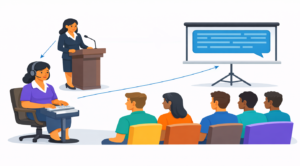
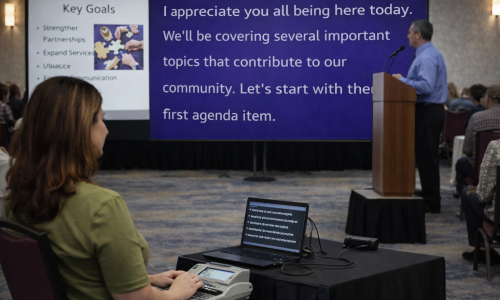
A certified CART provider attends your event in person with professional stenography equipment, delivering real-time word for word captions onto screens, monitors, or projection displays for all participants to follow. Onsite CART provides ADA compliant accessibility for events of any size, from classroom lectures and corporate trainings to large conferences and graduation ceremonies. We coordinate with you in advance to prepare event specific terminology and speaker details, ensuring accurate, seamless captioning from start to finish.
- Live Events
- Classrooms
- Meetings
- Conferences
Remote CART Services
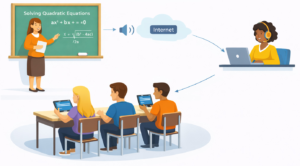
A certified CART provider connects to your event remotely through a secure audio or video link, delivering real-time word-for-word captions from an offsite location. Participants view live captions through a secure web link on any device or directly within platforms like Zoom, Microsoft Teams, and Google Meet. Remote CART provides ADA compliant accessibility with the same accuracy as onsite captioning, making it ideal for virtual meetings, webinars, online classes, and hybrid events that are online with participants in multiple locations.
- Virtual Meetings
- Webinars
- Online Classes
- Hybrid Events
CART for Every Setting
From corporate boardrooms to university classrooms, we provide professional captioning
wherever communication matters.
Education
Classrooms, lectures, campus wide events, orientations, graduations, and commencements with full transcript support
Corporate
Staff meetings, trainings, conference calls, and company-wide communications
Government
Public meetings, hearings, town halls, city council sessions, and civic events
Healthcare
Medical appointments, consultations, patient education, and procedures.
Performing Arts
Theater productions, concerts, services, and live entertainment venues
Conferences
Conventions, trade shows, seminars, workshops, and large scale events
Works With Your Favorite Platforms
CART captions integrate seamlessly with all major video conferencing and streaming platforms. We handle the technology so you can focus on your event.
Zoom
Google Meet
Microsoft Teams
GoTo Webinar
WebEx
Google Classroom
COMMON CART QUESTIONS
CART FAQs
What is CART and who uses it?
CART (Communication Access Realtime Translation) is a service where a trained professional converts spoken language into text displayed on a screen in realtime with 98%+ accuracy. CART providers use specialized stenotype equipment to capture speech as quickly as it is spoken.
CART is used by people who are Deaf or hard of hearing and prefer reading English over sign language, individuals with cochlear implants, late-deafened adults, and people with auditory processing disorders.
Why should I use CART instead of automatic captions?
Accuracy that matters: CART delivers 98-99% accuracy compared to auto-captions’ 60-80%. That 20-40% difference isn’t just numbers. It’s missed medication instructions, misunderstood legal rights, or lost educational content.
Auto-captions fail when it counts: They struggle with accents, technical terminology, multiple speakers, background noise, and crosstalk. A single misheard word can change “take two pills” to “take ten pills” or turn a “not guilty” into something else entirely.
CART captures the full picture: A trained CART provider identifies speakers, notes tone and emotion, and includes environmental sounds like “[laughter]” or “[applause]” that give context to the conversation.
Legal compliance: The ADA requires “effective communication.” In many professional settings, auto-captions do not meet this standard. CART is the recognized accommodation for education, healthcare, legal proceedings, and workplace communication.
Who can benefit from using CART?
CART benefits many individuals:
- Deaf and hard of hearing individuals who prefer reading English over sign language
- Late-deafened adults who may not know sign language
- Cochlear implant users who benefit from text support
- People with auditory processing disorders
- Non-native English speakers who find reading easier than listening
CART is commonly used in educational institutions, workplaces, conferences, medical appointments, legal proceedings, and public meetings.
What are the technical requirements for CART?
For onsite CART: You need display equipment such as a laptop, monitor, or projector screen where the text can be displayed for the individual to read.
For remote CART: Participants need a stable internet connection and a device with a screen to view captions. The CART provider must be able to hear the audio clearly, which may require high quality microphones or a direct audio feed.
Text display settings can be adjusted for individual visual preferences including font size, color, and contrast.
Is CART covered under the ADA?
Yes. The Americans with Disabilities Act requires public facilities, employers, educational institutions, and healthcare providers to provide reasonable accommodations for effective communication with people who are Deaf or hard of hearing. CART is a recognized accommodation under the ADA.
Organizations cannot deny CART services based on cost alone. If a Deaf or hard of hearing individual requests CART as their accommodation, the organization is generally required to provide it, just as they would be required to provide an ASL interpreter.
Is CART the same thing as closed captioning?
While both services provide text of spoken content, CART and closed captioning have important differences. CART (Communication Access Realtime Translation) is specifically designed for live, interactive settings and provides verbatim, word-for-word transcription in realtime with 98%+ accuracy.
Closed captioning is typically used for pre-recorded media (TV shows, movies, videos) and may be edited for brevity or reading speed. CART also includes environmental sounds, speaker identification, and contextual cues that make it particularly useful for live presentations, meetings, educational events, and situations requiring two-way communication. CART is the preferred accommodation for live events under the ADA.
What is the difference between remote and onsite CART?
On-site CART: The CART provider is physically present at the event and can hear speakers directly. Text is displayed on a screen visible to the individual receiving services.
Remote CART: The CART provider works from another location and receives audio through a phone line, microphone, or video feed. Text is transmitted via the internet and displayed on the participant’s device or projected screen.
Both options provide high quality realtime captioning. Remote CART offers flexibility and may be more readily available, while on-site CART may be preferred for complex multi-speaker events.
Do I receive a transcript after the CART session?
Yes, transcripts can be provided after CART sessions upon request. The raw CART output can be cleaned up and formatted as a written transcript of the event.
Let us know when booking if you would like a transcript, as additional fees may apply for transcript preparation and delivery. In Legal settings there must be a court order from the judge requesting the transcript of the proceeding.
Should I request CART or an ASL interpreter?
The choice depends on the Deaf or hard of hearing individual’s preference. Some individuals are native ASL users and prefer interpreters. Others prefer reading English text and request CART.
Always ask the individual what accommodation they prefer rather than assuming. Some events may require both CART and interpreters if multiple individuals with different preferences will attend.
How can CART be used in a Zoom meeting?
CART can be integrated into Zoom meetings in several ways:
- The CART provider can share their screen displaying the realtime text
- Zoom’s closed captioning feature allows a designated participant to input captions that appear as subtitles
- Zoom supports third party captioning services where you input a streaming URL
- The CART feed can be sent to a separate web based platform that participants view alongside Zoom
Test the setup before the actual meeting to ensure everything works smoothly. We can help you configure CART for your Zoom meetings.
How far in advance should I book CART services?
We recommend booking CART services at least one to two weeks in advance for routine appointments. For conferences, large events, or situations requiring multiple CART providers, book four to six weeks ahead.
CART same day requests incur a $50 surcharge. Contact us as soon as you know your CART needs to ensure availability.
Need More Help?
Explore Our Full FAQ
Our full FAQ page covers interpreting, billing, scheduling, legal services, and more.
Ready to Make your Event Accessible?
Contact us today to discuss your CART captioning needs. New customers start by completing our Rates & Policies form to get scheduled.